Affiliate Marketing
Best Affiliate Marketing Software for Bloggers 2026
The 6 best affiliate marketing tools for bloggers in 2026 — WordPress link managers and affiliate program platforms, with pricing verified against each vendor's own page on 3 November 2026.
Quick Picks — Best Affiliate Marketing Software for Bloggers 2026
- Best WordPress link manager: ThirstyAffiliates — the only tool here with Amazon Product Advertising API importing
- Best simple link cloaker: Pretty Links — clean UI, product displays, and an easy setup wizard
- Best for international Amazon traffic: Geniuslink — auto-localizes links to the right Amazon storefront
- Best affiliate program software (SaaS/digital products): FirstPromoter — built specifically for subscription businesses
- Best Stripe-native affiliate program: Rewardful — zero-friction setup if Stripe is already your payment processor
- Best for scale with 30+ integrations: Tapfiliate — the most integration-friendly platform in this list
Pricing verified 3 November 2026 against each vendor’s own pricing page: ThirstyAffiliates, Pretty Links, Geniuslink, FirstPromoter, Rewardful, Tapfiliate. Affiliate tool pricing changes often and several of these run introductory rates — check the current page before buying.
Here is a truth most affiliate marketing guides skip: “affiliate marketing software” is not one category. It is two completely different problems wearing the same name.
Problem one: You are a blogger promoting other people’s products. You have 300 affiliate links scattered across 5 years of posts and no idea which ones still work, which ones earn, or where you even put the Amazon Associates link for that camera you reviewed in 2023. You need a link manager.
Problem two: You have created your own digital product — a course, a SaaS tool, an ebook — and you want other bloggers and creators to promote it for a commission. You need an affiliate program platform.
Most roundups lump all of this together and leave you confused. This one separates them, then gets specific about pricing — including the parts the pricing pages bury.
Part 1: Affiliate Link Management Tools
These are for bloggers who promote other people’s products. You already have affiliate relationships. You just need a smarter way to manage, track, and protect those links inside WordPress.
1. ThirstyAffiliates — Best All-Around WordPress Affiliate Link Manager
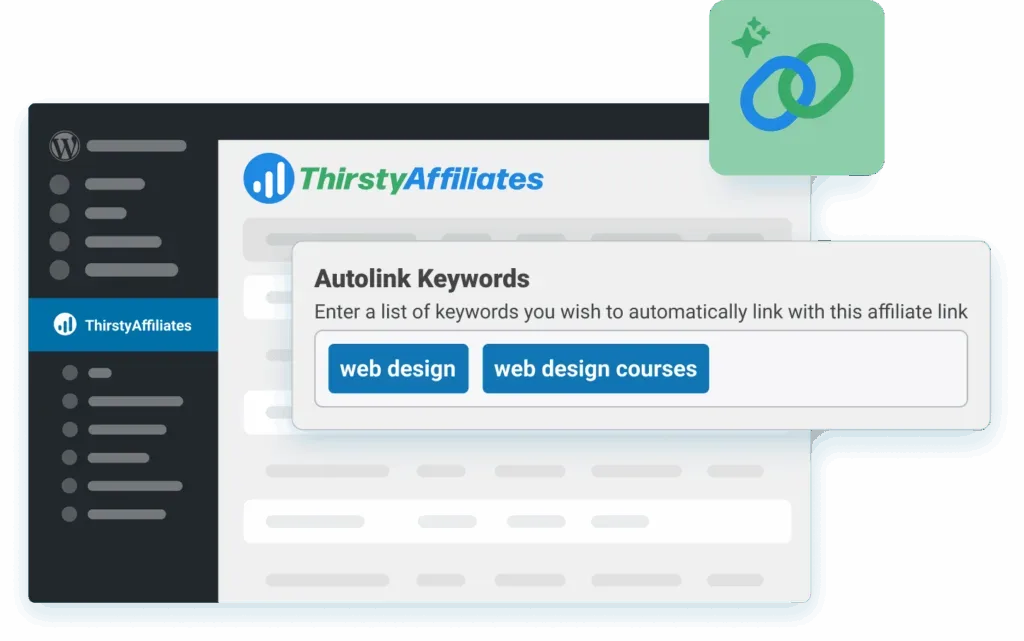
ThirstyAffiliates does one thing and does it well: it takes the operational grind out of managing affiliate links on a WordPress blog. The auto-linking feature is the headline act. You add a keyword — say, “Elementor” — and ThirstyAffiliates automatically inserts your affiliate link every time that word appears in a post. Retroactively. Across your entire site.
That matters most for blogs with a back catalogue. If you have been publishing for a few years you almost certainly have unleveraged content — posts that mention products but never got affiliate links because adding them manually was too tedious. Auto-linking clears that backlog in one pass.

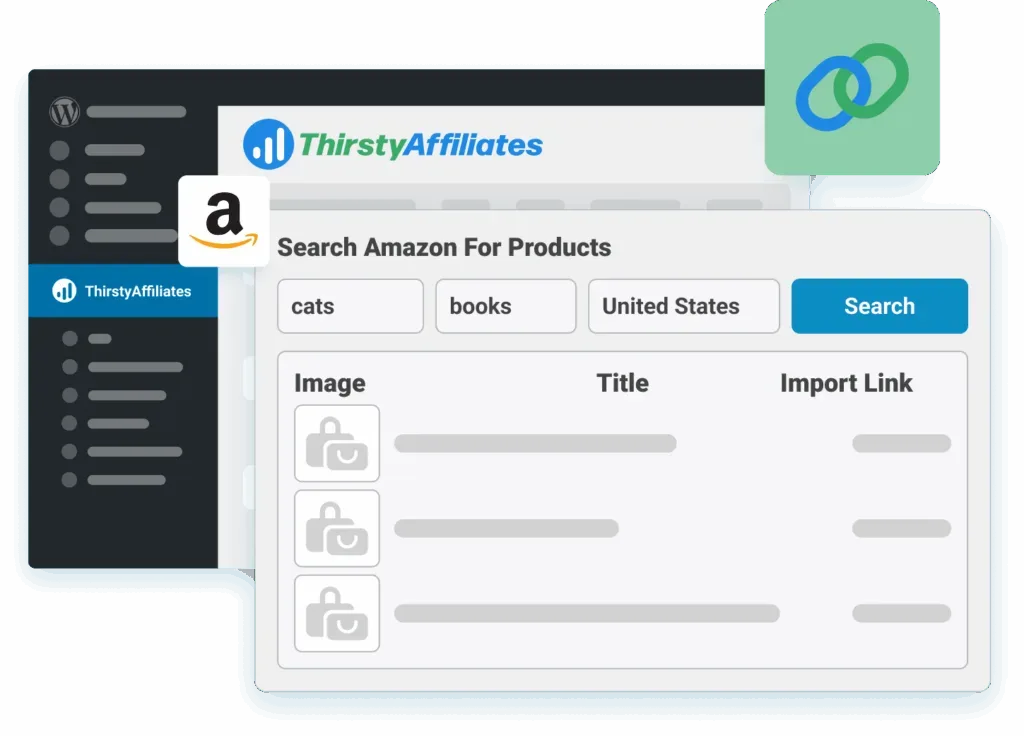
The Amazon Associates integration is the real differentiator in this list. ThirstyAffiliates imports product data through Amazon’s Product Advertising API, meaning you can insert product images and prices that update dynamically — no more posts showing a $29 price when the product now costs $47. Pretty Links, its closest competitor, has no equivalent.
What I Like
- Auto-linking works retroactively across all existing content
- Amazon Product Advertising API importing pulls live prices and images
- Click stats per link are granular enough to actually act on
- Link health monitoring flags broken redirects before readers find them
- Geographic redirects, keyword linking and Amazon importing are all listed on the entry Basic plan — you do not need to buy up a tier for the headline features
What I Do Not Like
- The free WordPress.org plugin is deliberately limited — the automation features are the paid upgrade
- The UI is functional but dated compared to Pretty Links
- No built-in product display boxes without add-ons
- Introductory pricing makes the real long-term cost hard to pin down (see below)
Pricing
As of November 2026: Basic $99.60/yr (1 site), Plus $149.60/yr (5 sites), Advanced $199.60/yr (10 sites). These are explicitly introductory rates — the page footnote reads “Special introductory pricing; all annual renewals are at full price,” and shows “normally” prices of $249, $374 and $499 respectively. ThirstyAffiliates does not publish the exact renewal figure anywhere, so budget on the assumption that year two costs materially more than year one and confirm the number before you commit. There is a 14-day money-back guarantee, and a free version on the WordPress.org plugin repository with 30,000+ active installs. See current pricing →
Verdict: The best option for bloggers who want maximum control over affiliate links inside WordPress, and the only one here with Amazon API importing. If you are an Amazon-heavy blogger, this is the pick.
2. Pretty Links — Best for Clean Links, Product Displays, and Simplicity

If ThirstyAffiliates is the Swiss Army knife of affiliate link management, Pretty Links is the chef’s knife — it does fewer things but does them with more polish. The dashboard is noticeably cleaner, the setup wizard is friendlier, and the product display templates look better than what you get from ThirstyAffiliates.
The Link in Bio feature is good for bloggers who drive traffic from Instagram or TikTok. Instead of pointing your bio link to your homepage, you build a branded page inside your own WordPress site that showcases your top affiliate offers — fully tracked, no third-party dependency. Note that it is positioned as an add-on from the Marketer tier rather than something included at the entry level.

PrettyPay is an interesting addition: you can create one-click checkout links for your own digital products (ebooks, templates, guides) and sell them directly without building a storefront. It is not a full e-commerce replacement, but for a blogger selling a $27 PDF it covers the basics, and Pretty Links takes no transaction fee on it.
What I Like
- Cleaner UI and faster onboarding than ThirstyAffiliates
- Product display templates that present better than plain text links
- Link in Bio page builder hosted on your own WordPress domain
- LinkHealth monitors every link and alerts you to 404s
- Smart redirects based on location, device, or time
- The free plugin is far more widely adopted — 200,000+ active installs versus 30,000+ for ThirstyAffiliates
What I Do Not Like
- No Amazon Product Advertising API integration. There is no Amazon API row anywhere in the feature comparison and no Amazon API feature page on the site. For Amazon affiliates this is the deciding factor against it
- Fewer sites per tier than ThirstyAffiliates at identical prices — 1/2/5 versus 1/5/10
- Same introductory-pricing uncertainty as ThirstyAffiliates
Pricing
As of November 2026: Beginner $99.60/yr (1 site), Marketer $149.60/yr (2 sites), Super Affiliate $199.60/yr (5 sites) — introductory rates, with “normally” prices of $249, $374 and $499 and the same “all annual renewals are at full price” footnote. Exact renewal figures are not published. 14-day money-back guarantee, and a free version on the WordPress.org plugin repository. See current pricing →
Verdict: Pick Pretty Links if visual presentation matters to you and Amazon is not central to your affiliate income. The product display boxes and Link in Bio feature give your content a professional look ThirstyAffiliates cannot match without add-ons. If you are Amazon-heavy, this is the wrong tool — go ThirstyAffiliates.
3. Geniuslink — Best for International Traffic and Amazon Localization

Here is a problem most Amazon affiliates do not realize they have: when a reader in Canada clicks your Amazon.com affiliate link, you generally do not earn a commission on what they end up buying. The reader lands on Amazon.com, gets routed to Amazon.ca, and your affiliate tag does not follow.
Geniuslink solves this. It detects the reader’s country and rewrites the link destination on the fly — an American reader gets Amazon.com, a UK reader gets Amazon.co.uk, a Canadian reader gets Amazon.ca, with your affiliate ID for that marketplace attached. Geniuslink’s localization page states support for over 20 stores. For bloggers with international audiences, this is recoverable revenue you are currently losing.
The Choice Pages feature is worth singling out. Instead of linking directly to a product, you create a landing page that shows multiple buying options — Amazon, Barnes & Noble, Kobo, wherever — and readers pick their preferred retailer. Geniuslink markets this as “2x sales”; treat that as the vendor’s own claim rather than an independent finding, but the underlying logic is sound: you are serving every reader’s preference instead of forcing one platform.
What I Like
- Automatic Amazon link localization across 20+ storefronts with no per-country setup
- Choice Pages let readers pick their preferred retailer
- Usage-based pricing means a small blog pays very little
- Mobile deep linking sends shoppers to the Amazon app on mobile
- Chrome extension creates localized links in two clicks while browsing
- Bot and junk clicks are not billed
What I Do Not Like
- Not a WordPress plugin — requires a separate account and link creation workflow
- Per-click billing scales with traffic, so high-volume blogs should model the cost carefully
- Analytics are solid but not as deep as a dedicated link manager
- A custom domain is an extra $50/month — significant relative to the $6 base
Pricing
As of November 2026: $6/mo base including 1,000 clicks, then $3.50 per additional 1,000 clicks, billed in 1,000-click buckets. Geniuslink’s own worked example: 3,000 clicks/month = $13.00. At 10,000 clicks/month the list rate works out to $37.50, though the page advertises volume discounts of up to 50%, so high-traffic blogs should ask rather than assume list price. Optional custom domain adds $50/mo. 14-day free trial with unlimited clicks; a valid credit card is required. See current pricing →
Verdict: Close to non-negotiable if you have meaningful international traffic and use Amazon’s affiliate program. For bloggers whose traffic is 90%+ domestic, the ROI is lower and you are better served by ThirstyAffiliates or Pretty Links.
Part 2: Affiliate Program Management Platforms
These tools are for when you have crossed from promoting other people’s products to selling your own. You have a course, a SaaS subscription, a template pack, a membership — and you want to build a team of affiliates who will promote it in exchange for a commission. You need a program management platform, not a link manager.
One structural thing to understand before you compare prices: both FirstPromoter and Rewardful price by the monthly revenue your affiliates generate, not by how many affiliates you have. Two programs paying the same monthly fee can have wildly different affiliate counts. The ceiling that matters is the revenue ceiling, and it is where these two actually differ.
4. FirstPromoter — Best for SaaS and Subscription-Based Digital Products
FirstPromoter is built specifically for subscription businesses — SaaS products, membership sites, recurring revenue. That narrow focus means it does things other platforms do not: it ties commissions to actual billing events rather than just signups, handles lifetime recurring commissions correctly, and collects the tax paperwork (W-9 and W-8BEN) that most affiliate platforms ignore until it becomes a compliance problem. Tax form collection is included on every plan, which is unusual at this price.
Performance tiers are a standout feature, and they are available on all three plans. You can set a revenue threshold — say, $2,000/month in referred revenue — and affiliates who hit it automatically move to a higher commission tier without you manually adjusting anything. The system handles the upgrade on the next qualifying sale.
Be precise about the affiliate portal, though, because the marketing is easy to misread. Every plan gives your affiliates a brandable dashboard with your logo and colours. A custom dashboard domain starts at Business. Full white-labelling — custom CSS/JS with the “powered by” link removed — is Enterprise only. If a fully unbranded partner experience is a requirement, you are buying Enterprise.
What I Like
- Commission attribution tied to billing events, not just clicks or signups
- Lifetime recurring commissions handled correctly for subscription products
- Performance tiers on every plan, upgrading affiliates automatically at revenue thresholds
- W-9 / W-8BEN collection built in on every plan — affiliates submit tax forms through their portal
- Coupon code tracking works across every channel, not just links
- Unlimited team members on all plans
What I Do Not Like
- Plan limits key off monthly affiliate-referred revenue, which surprises people expecting affiliate-count pricing
- Full white-labelling and managed auto-payouts are both Enterprise-only
- Managed Auto Payouts is restricted to SaaS companies and requires approval — not a feature you can simply switch on
- Interface feels more complex than Rewardful at the same price point
Pricing
As of November 2026: Starter $49/mo or $490/yr (up to $5,000/mo affiliate revenue, max 1,000 affiliates, 3 campaigns), Business $99/mo or $990/yr (up to $15,000/mo, unlimited affiliates and campaigns, 2 websites), Enterprise $149/mo or $1,490/yr (above $15,000/mo, 3 websites). 14-day free trial, no credit card required. See current pricing →
Verdict: The best choice for bloggers who have a SaaS product or a recurring membership. Tax compliance and performance tiers on every plan put it ahead of the competition at this price — just check which tier your white-label and payout requirements actually land on.
5. Rewardful — Best Stripe-Native Affiliate Program for Fast Setup
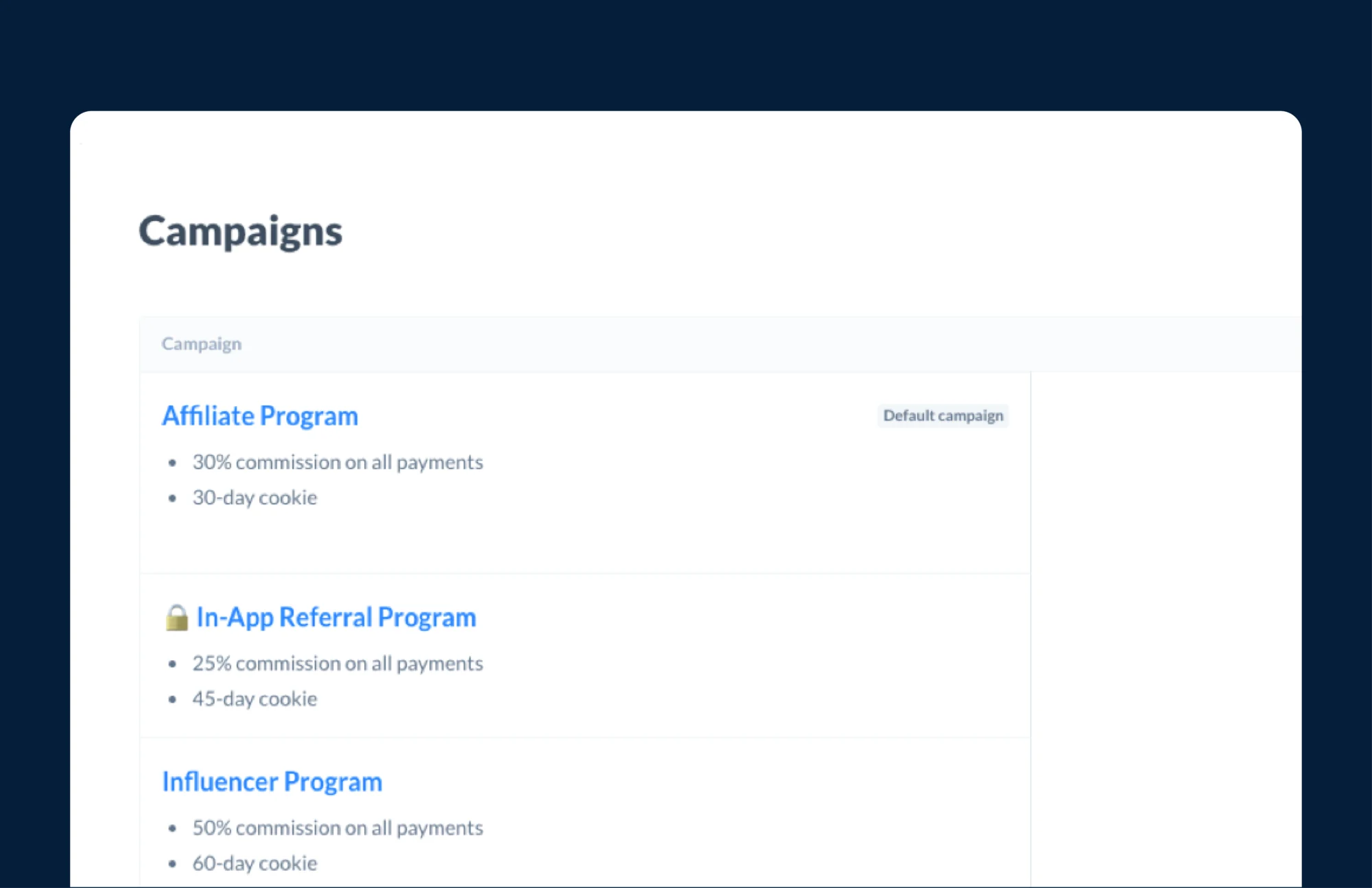
Rewardful’s pitch is a fast setup, and it is largely true. If you already charge customers through Stripe — Rewardful is a Stripe Premier Partner — you paste two JavaScript snippets, connect your Stripe account, and Rewardful starts tracking referrals. There is no webhook configuration, no custom events to fire, no developer required. For a solo blogger launching their first digital product, that matters enormously.
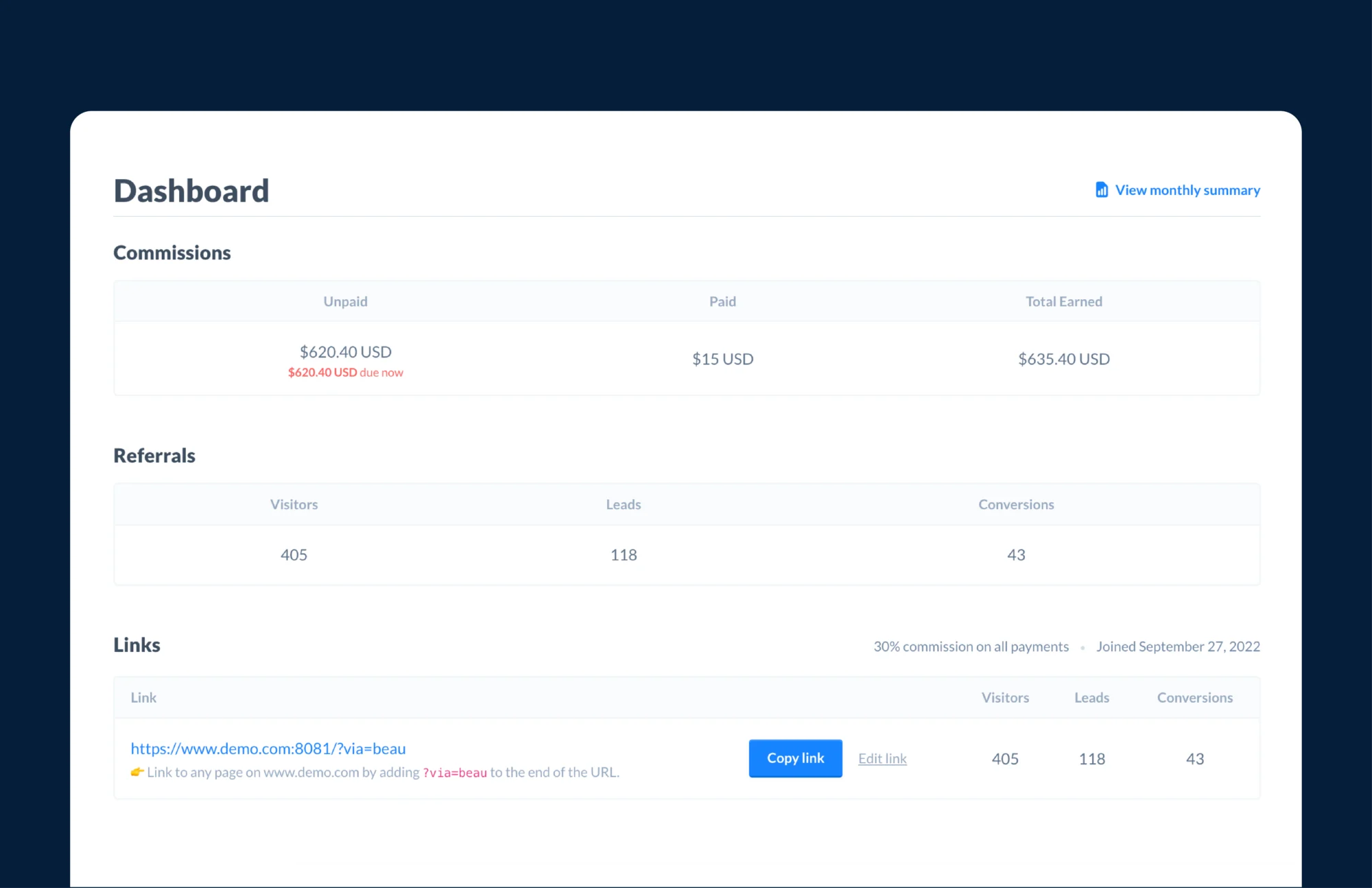
The Two-Way Stripe Sync is genuinely useful: you can see affiliate-attributed revenue, commissions owed, and refunds directly in your Stripe dashboard. For bloggers who live in Stripe, this is a cleaner workflow than logging into a separate analytics tool.
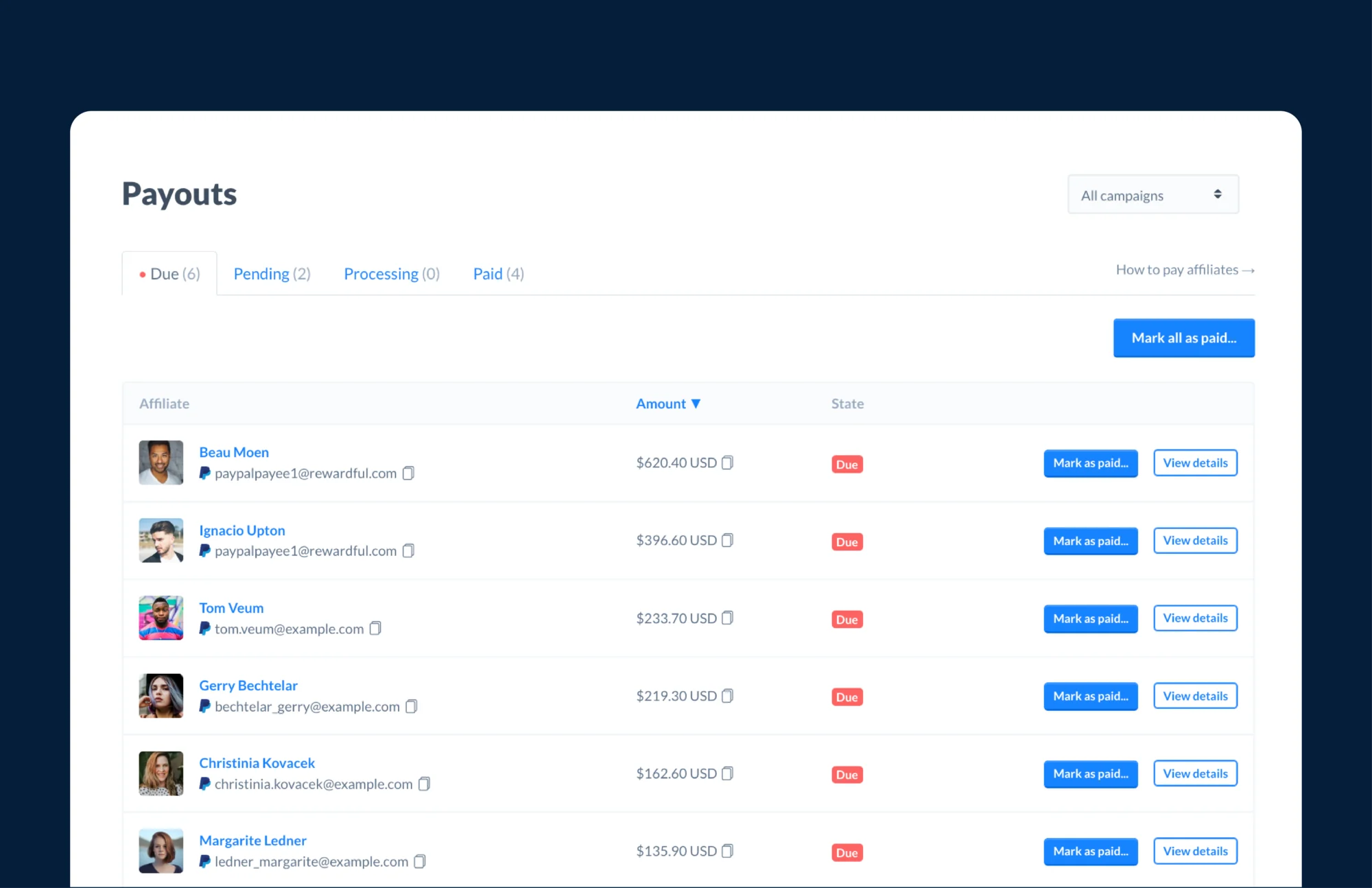
Zero transaction fee on affiliate-attributed revenue is the other thing worth knowing, and Rewardful states it unambiguously: the subscription fee is the cost, and it takes 0% of affiliate revenue. Many affiliate platforms clip a percentage of every affiliate sale. One caveat to read properly: if you use Rewardful’s optional Managed Payouts to pay affiliates, there is a 3% processing fee for merchants. The 0% applies to your revenue, not to that payout service.
What I Like
- Genuinely fast setup — Stripe integration works without developer involvement
- Two-Way Stripe Sync shows affiliate data inside your existing Stripe dashboard
- 0% transaction fee on affiliate-attributed revenue, on every plan
- Higher entry revenue ceiling than FirstPromoter at the same $49 price — $7,500/mo vs $5,000/mo
- Coupon code tracking for influencer campaigns where links do not work
- Self-referral fraud detection runs automatically
- Unlimited affiliates on every plan, including Starter
What I Do Not Like
- Stripe and Paddle are the processors named on the pricing page — if you bill through something else, verify support before committing
- Starter is capped at 1 campaign and 2 team members
- No performance-tier feature, so automatic commission escalation is not available the way it is on FirstPromoter
- Managed Payouts carries a 3% merchant processing fee
Pricing
As of November 2026: Starter $49/mo or $490/yr (up to $7,500/mo affiliate-attributed revenue, 1 campaign, 2 team members), Growth $99/mo or $990/yr (up to $15,000/mo, unlimited campaigns and team members), Enterprise from $149/mo or $1,490/yr (up to $30,000/mo on the entry tier, then tiered upward). Affiliates and visitors unlimited on all plans. 14-day free trial on every plan. See current pricing →
Verdict: The fastest way to launch an affiliate program for a Stripe-based digital product, and the better value at the entry tier thanks to the higher revenue ceiling. If you already use Stripe and want to start generating affiliate revenue this week without involving a developer, Rewardful is the answer.
6. Tapfiliate — Best for Scale and Integration Depth
Tapfiliate is what you choose when your affiliate program starts to feel like its own business. It advertises 30+ integrations out of the box — Shopify, Stripe, PayPal, Zapier and more — so you can automate commission triggers from most payment or CRM stacks. Worth noting that the Zapier connection’s “5,000+ apps” figure is Zapier’s reach, not Tapfiliate’s own integration count.
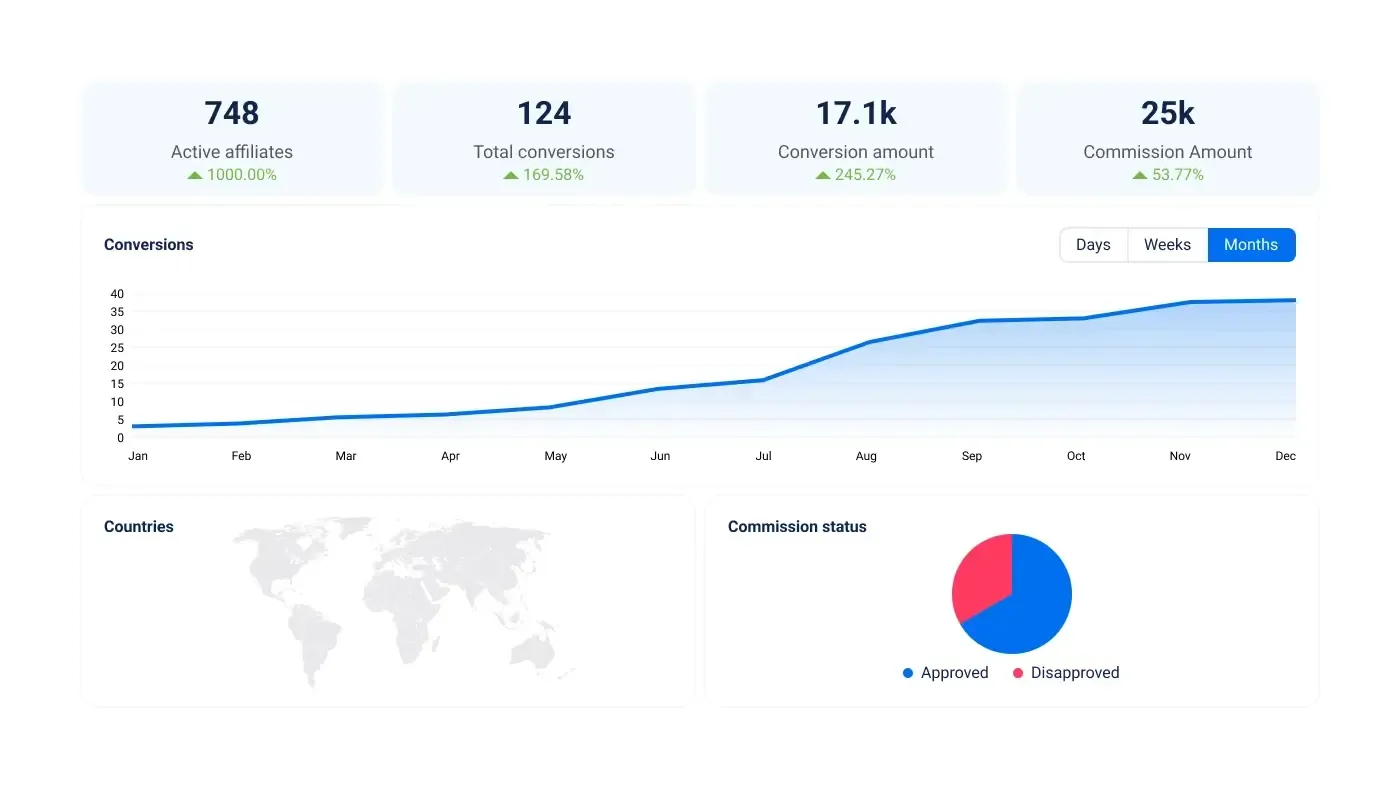
The commission flexibility is deeper than Rewardful. You can run flat fees, percentage commissions, tiered structures, and bonus payouts in parallel — different rules for different affiliate segments, with coupon code support alongside link tracking. Bloggers running complex multi-tier programs with influencer-specific coupon codes will find the configurability useful.
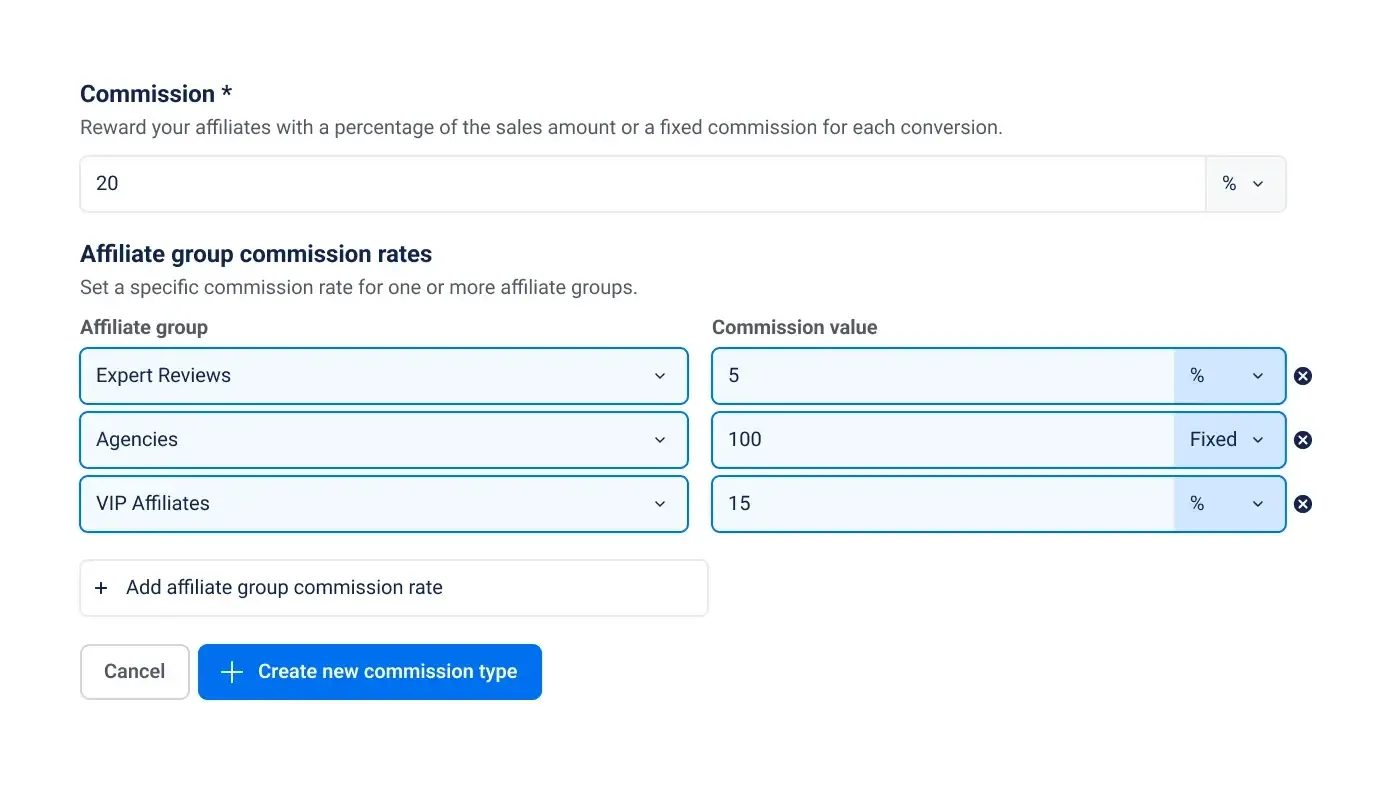
Reporting is Tapfiliate’s strongest suit. You can filter by affiliate, program, conversion source and date range, and compare periods side by side. For bloggers managing 50+ affiliates across multiple products, this level of reporting clarity is how you actually decide which affiliates to invest in.
The other structural difference: unlike FirstPromoter and Rewardful, Tapfiliate’s plans cap affiliate and program counts rather than revenue. If your program generates high revenue from a small affiliate roster, that can work out considerably cheaper.
What I Like
- 30+ native integrations covering most major payment and CRM platforms
- Deep commission flexibility: flat, percentage, tiered, and bonus payouts per segment
- Robust reporting with side-by-side period comparisons
- Multi-program support on Scale — run different programs with different rules from one account
- Capped on affiliates rather than revenue, which suits high-revenue/low-affiliate-count programs
What I Do Not Like
- The Launch plan’s 50-affiliate, 1-program cap is tight for fast-growing programs
- Setup has a steeper learning curve than Rewardful
- Tax form collection (W-9/W-8BEN) is not mentioned anywhere on the pricing page — unlike FirstPromoter, where it is explicitly included. Confirm with Tapfiliate before assuming either way
- No published Enterprise pricing
Pricing
As of November 2026: Launch $89/mo billed monthly or $74/mo billed annually (50 affiliates, 1 program); Scale $179/mo billed monthly or $149/mo billed annually (unlimited affiliates and programs); Enterprise is contact-sales with no published price. 14-day free trial on all plans. See current pricing →
Verdict: The right pick for bloggers whose product has scaled to the point where the affiliate program needs its own management infrastructure, or whose revenue would push them into an expensive tier on revenue-priced platforms. Slightly overkill for a solo blogger launching a first course — start with Rewardful and migrate when you outgrow it.
The Thing Nobody Mentions: Two of These Are the Same Company
ThirstyAffiliates and Pretty Links are both Caseproof products, and as of November 2026 their pricing is identical — $99.60 / $149.60 / $199.60, the same “normally $249 / $374 / $499” full-price figures, and the same introductory-pricing footnote on both pages.
That changes how you should compare them. You are not weighing a cheap option against an expensive one; you are choosing between two similarly priced products from the same company with different strengths. The two differences that actually matter:
- Amazon Product Advertising API: ThirstyAffiliates has it. Pretty Links does not. If Amazon is a meaningful share of your affiliate income, this decides it.
- Sites per licence: ThirstyAffiliates gives 1 / 5 / 10. Pretty Links gives 1 / 2 / 5. At the same price, ThirstyAffiliates covers more sites.
Pretty Links earns its place on polish, the product display templates, Link in Bio, and a free plugin with roughly six times the install base. But if you were assuming the higher-priced tier of one was better value than the other, it is not that simple.
Side-by-Side Comparison
| Tool | Best For | Starting Price | What the Plan Caps | Free Tier / Trial |
|---|---|---|---|---|
| ThirstyAffiliates | WordPress link management, Amazon affiliates | $99.60/yr intro (normally $249) | Sites (1 / 5 / 10) | Free WordPress.org plugin |
| Pretty Links | Clean links + product displays | $99.60/yr intro (normally $249) | Sites (1 / 2 / 5) | Free WordPress.org plugin |
| Geniuslink | International Amazon traffic | $6/mo + $3.50 per 1,000 clicks | Clicks (usage-based) | 14-day trial, card required |
| FirstPromoter | SaaS / subscription products | $49/mo or $490/yr | Affiliate revenue ($5k / $15k / above) | 14-day trial, no card |
| Rewardful | Fast Stripe-based program setup | $49/mo or $490/yr | Affiliate revenue ($7.5k / $15k / $30k) | 14-day trial |
| Tapfiliate | Scale with multiple integrations | $74/mo annual, $89/mo monthly | Affiliates & programs (50 / unlimited) | 14-day trial |
How to Choose the Right Tool
Choose ThirstyAffiliates if: You are an Amazon affiliate, or you run several sites. It is the only tool here with Amazon API importing, and it covers twice as many sites as Pretty Links at every price point.
Choose Pretty Links if: Amazon is not central to your income, you want a more polished UI, you plan to sell digital products alongside affiliate promotions, or you drive meaningful traffic from Instagram or TikTok where a Link in Bio page adds value.
Choose Geniuslink if: Google Analytics shows a meaningful share of your traffic coming from outside your primary country, and you promote Amazon products. At $6/mo plus usage, the entry cost is low enough to test against one month of recovered international commissions.
Choose FirstPromoter if: You sell a SaaS product or subscription membership and want performance tiers and built-in tax compliance on the entry plan. Check whether your white-label and payout needs push you to Enterprise before you budget.
Choose Rewardful if: You already use Stripe, you want to launch this week without a developer, and your commission structure is relatively simple. Its $7,500/mo entry revenue ceiling beats FirstPromoter’s $5,000 at the same price.
Choose Tapfiliate if: Your program has outgrown simpler tools, you need multiple integrations, or your revenue is high relative to your affiliate count — because it caps affiliates rather than revenue.
Final Verdict
The single most common mistake bloggers make is choosing the wrong category of tool. If you promote other people’s products, you need ThirstyAffiliates or Pretty Links — not Rewardful. If you have a product to sell and want affiliates to promote it, you need Rewardful or FirstPromoter — not ThirstyAffiliates.
For most bloggers starting out: ThirstyAffiliates for managing the affiliate links you already have, and Rewardful the moment you launch your own product. Both are the lowest-friction entry points in their categories, and neither requires a developer to set up.
For bloggers with international audiences: add Geniuslink to whatever else you are using. The entry cost is modest; the recovered international commissions are not.
Two cost warnings before you buy. The WordPress plugins are on introductory pricing and neither publishes its renewal figure, so year two will cost more than year one by an amount you cannot currently look up. And on the program platforms, the number that determines your bill is your affiliate-generated revenue, not your affiliate count — so model your own numbers against each plan’s ceiling rather than comparing headline prices.
Frequently Asked Questions
What is the best affiliate marketing software for beginner bloggers?
ThirstyAffiliates and Pretty Links are the best starting points. Both have free versions on the WordPress.org plugin repository, simple setup wizards, and link cloaking built in. ThirstyAffiliates edges ahead for bloggers who want Amazon Product Advertising API importing, which Pretty Links does not offer.
Do I need special software to manage affiliate links on my blog?
Not technically, but tools like ThirstyAffiliates and Pretty Links let you cloak links, auto-insert keywords, track every click, and update dead links across hundreds of posts without touching each one individually. The time savings alone make them worthwhile for any blogger with more than 20 active affiliate relationships.
What is the difference between affiliate link management and affiliate program management software?
Link management software (ThirstyAffiliates, Pretty Links, Geniuslink) helps you organize and track the affiliate links you promote on your own blog. Affiliate program management software (FirstPromoter, Rewardful, Tapfiliate) lets you run your own affiliate program so other people can promote your products and earn commissions.
Is Geniuslink worth it for Amazon affiliate bloggers?
If a meaningful share of your traffic comes from outside your home country, yes. Geniuslink automatically routes international visitors to their local Amazon storefront — it supports over 20 stores — so you capture commissions you would otherwise lose. For purely domestic blogs, the value proposition is weaker. At $6/mo plus $3.50 per 1,000 clicks beyond the first 1,000, the entry cost is low enough to test for a month.
Which affiliate program software is best for a blogger launching a digital product?
Rewardful is the fastest path if you already charge via Stripe, and its entry plan allows up to $7,500/month in affiliate-attributed revenue versus FirstPromoter’s $5,000 at the same $49/month price. FirstPromoter is the better pick if you need performance tiers that escalate commissions automatically, or built-in W-9/W-8BEN tax form collection, both of which it includes on every plan.
Do ThirstyAffiliates and Pretty Links cost the same?
As of November 2026, yes — both are Caseproof products priced at $99.60, $149.60 and $199.60 per year on introductory rates, with the same “normally $249 / $374 / $499” full prices. The differences are in what you get: ThirstyAffiliates covers 1, 5 and 10 sites per tier and includes Amazon Product Advertising API importing; Pretty Links covers 1, 2 and 5 sites and has no Amazon API integration, but offers better product display templates and a Link in Bio builder.
Written by the SoftwareReviewHQ team. All pricing read from each vendor’s own pricing page on 3 November 2026 and reflects published list prices, not negotiated rates. Some links on this page may be affiliate links; we may earn a commission if you sign up through them, at no extra cost to you.